Walking around I’m often surprised that nobody cares about the large tin-boxes around of us at all time. Taking space, speeding, polluting the air we breathe. Looking at the actual numbers, will shock you too.
This view of our car-centric society doesn’t come from someone raised on a beautiful greenfield surrounded by mountains with people getting by on their horses. Most of my life, I’ve been around cars, got to school in a car, went grocery shopping in a car. That is what happen when you grow up anywhere but a big city. Cars matter.
Growing up was not something that caught my attention, like most things in life you accepted as part of your routine, didn’t question it, really.
And yet, I admit their usefulness, I do use cars sometimes and I believe they have their place. I just think it their footprint in our lives, both financial and time wise, could be much smaller.
The cars army
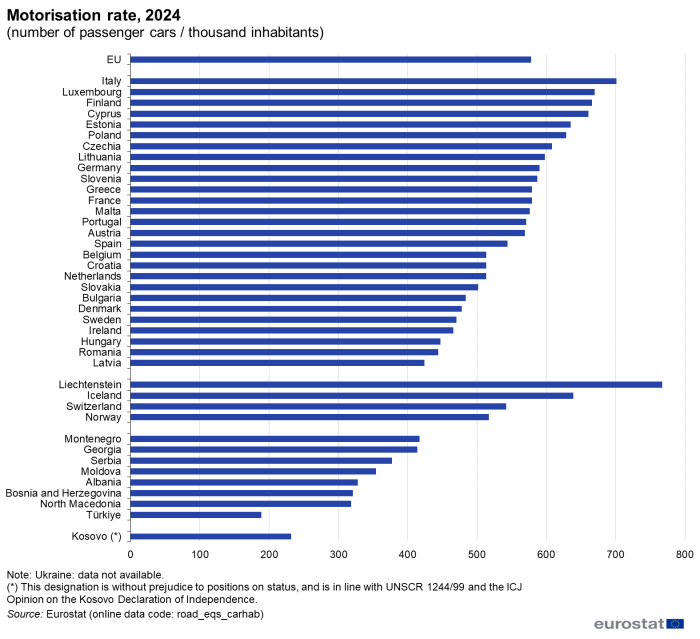
For obvious reasons I’m particularly interested in Italy’s stats.
Italy heads the list (701 passenger cars per 1000 inhabitants)
Second only to Germany in absolute numbers (~49mil cars) but with a much bigger population. 😂
This would be already remarkable for any country, but it is even more if you consider italy’s demographics.
As of 2024 Italy’s has 41.340.516 1 cars and 58.971.230 2 inhabitants, of which 17% are aged 0-19 and 4% are 85+.
If we exclude these two categories as non-driving population we have an even more shocking number:
887 cars per 1000 inhabitants.
If you try to reason about the numbers a few considerations come to mind:
- Territorial morphology, lot of mountains and hills, making it less convenient for non-motorized means of transportation (e.g. bike)
- Longer country, there is over 1600km between Swiss border and the very bottom of Sicily. That’s a 20h drive in best cases.
- Unreliable public transportation in many cities. Especially cities in the center and south of Italy lack consistent transportation people can rely on for daily commutes.
- Homegrown Automotive industry (FIAT) importance in the last centuries.
The public transport paradox
One more interesting point from eurostat data is the 6.3% increase in passenger cars during 2019-2024.
Yes, during this time we had a pandemic that forced us away from sharing transportation with others, but also a spike in inflation that could have reduce the budget for private passenger cars.
Instead, sales were not affected.
For once Italy is not leading the way, with a below-the-average 5% increase.
Yet, we see an increase despite the fact that cities like Milan have opened not one but two new metro lines in the last ten years, and overall city-to-city connections in Italy are considered above EU average.
Would be great to have more localized data, such as the one from Milan, to correlate improvements in public transportation and number of passenger cars.